The Ultimate Guide to Math Matching Games
Feb 23, 2026
We've all been there. You hand out a practice worksheet on a challenging topic—like solving systems of equations or factoring quadratics—and you immediately see your students glaze over and likely toss it straight in the trash.
For many students, a page filled with 20 problems isn't just a worksheet; it's an invitation to feel completely overwhelmed.
If you are looking for a way to break that cycle and bring some energy back into your classroom, it's time to lean into a hands-on algebra math game. Specifically, one of my absolute favorite "pattern interrupts": Math Matching Games (also known as Cut and Paste activities).
What is a Math Matching Game?
At its core, a matching activity shifts the focus from "doing a chore" to "solving a puzzle". Instead of staring at a blank page, students are given the pieces (the answers or next steps) and asked to fit them together.
It turns abstract Algebra concepts into a tangible, self-checking puzzle that gets students off their devices and using their hands.
So many of my high school intervention students had no interest in a worksheet, but hand them a cut and paste page with scissors and glue, and they were ready to go.
Why Cut & Paste Wins in the Secondary Classroom
There is a massive misconception that once kids hit middle or high school, they are "too old" for scissors and glue. That couldn't be further from the truth.
- Reduces Math Anxiety: By seeing the steps or answers on strips of paper, students feel more supported. Their job is to find the logical connection, which solidifies their understanding without the fear of a blank page.
- The Ultimate Self-Check: Matching games are inherently self-checking activities. If a student solves a problem and doesn't see their answer in the scrambled bank, they know immediately they need to take a look at their work again. No waiting for the teacher to grade it.
- Encourages Math Discourse: I always suggest using partners for matching games. When students have to decide which piece goes where, they start having real conversations about the math: "Wait, that can't be the next step because the negative sign didn't distribute".
- Kinesthetic Learning: Let's be honest, some kids just need to move. The simple act of cutting out strips and physically moving them into the correct spot on a graphic organizer engages the brain differently than a pencil and paper. It provides a physical "reset" that helps them focus.
Choosing the Right Math for Matching
You can use matching games for almost anything, but they shine brightest when used for multi-step processes or vocabulary. Just because it involves glue doesn't mean it's "fluff." You can use these for rigorous, DOK 2 and 3 level tasks.
- Great for Matching: Writing Equations in Slope-Intercept Form, Factoring Quadratics, Solving Systems of Equations. (Having them match the system to the correct coordinate pair answer).
- Not Great for Matching: Basic addition/subtraction drills. (It takes longer to cut the paper than to do the math!)
My three favorite topics for cut and paste activities are:
- Graphing linear functions in slope intercept form
- Graphing quadratics
- Graphing systems of equations
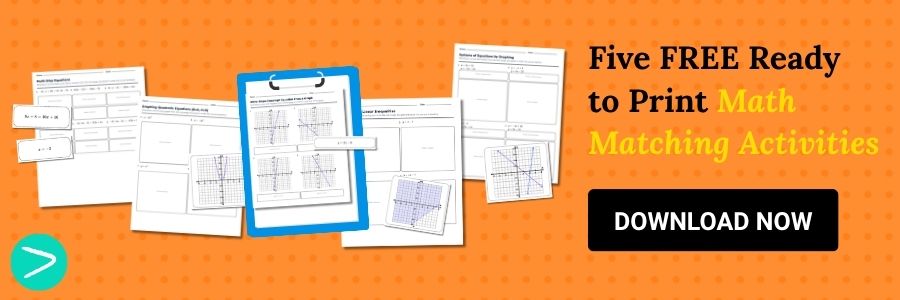
You can download all three of them (plus two more) for FREE by clicking here.
Step-by-Step: Teacher Prep & Facilitation
Setting this up shouldn't take you all night. In fact, with the right tools, it takes about 30 seconds.
- Materials: You will need glue sticks and scissors for your students.
- Print & Prep: Create your matching activity and print it. You will pass out two things to students in pairs: One, the page with the original problems, where they will glue on the answers. Two, the page of mixed up strips, steps, and answers for students to cut out.
- Show Work Separately: Because they are pasting over the boxes, encourage students to show work on a separate sheet of paper or a dedicated graphic organizer.
- Paste and Check: Once they are confident in their "puzzle," they paste the answers onto the organizer for a finished product they can actually feel proud of.
Juliana's Classroom Management Hacks
If the thought of paper scraps all over your floor gives you hives, don't worry. Here is how I manage the mess:
- The "Trash Can Hack": Manage the mess easily by walking around with the recycling bin while they work. Have them immediately throw away the border scraps. It keeps the room clean and gives you a natural, low-pressure excuse to check in on every single pair's progress.
- The Instant Graphic Organizer: If we do not require students to show work for a cut and paste, we run the risk of it not actually getting them to practice the Math. The answer? Have each partner pair take out a piece of paper and fold it into 4 boxes. Now they have an instant graphic organizer to show work for 8 problems. Let them know that turning in their organizer is part of the Matching activity grade. If you do want them up and moving, check out my Ultimate Guide to Math Scavenger Hunts.
The Ultimate Hack: The Math Activity Accelerator
We know you're exhausted from lesson planning and spending way too much money on static PDFs from teacher websites. You deserve your nights and weekends back.
If you've ever tried to make your own matching game in Microsoft Word or Google Docs, you know it is a formatting nightmare. Aligning text boxes, drawing dotted scissor lines, and remembering to manually scramble the answer key takes hours.
With the Math Activity Accelerator, you can stop the Sunday scaries.
- Zero Formatting Fights: The engine handles the alignment, the scissor lines, and the scrambled answer bank automatically. You just hit print.
- 100% "AI-Free" Math: Say goodbye to "hallucinated" numbers. Our engine uses real coded math logic, so you never get fake math, impossible answers, or duplicates.
- Customize the Challenge: Need 6 problems instead of 12? One click.
- Seasonal Flair: Add secondary-student-approved borders to keep things fresh. One click.
Ready to see your students actually enjoy doing math? You can generate, customize, and print a high-quality, beautiful resource instantly for free right here.
Cut & Paste FAQ
Q: Are cut and paste activities appropriate for high school students?
A: Absolutely! I did them with my 9th, 10th, and 11th graders in repeat Algebra 1 and they loved it.
Q: How do you grade a math matching game?
A: You don’t need to! It’s a self-checking activity because if they solve the problem and do not see the answer to paste under it, they know they have an error. I would encourage you to require students turn in their work (using the instant graphic organizer hack from the previous section) so that you can see that they did actually practice.
Q: What do I do if a student loses one of their cut-out answer strips?
A: Honestly, they’ll find it. They may drive themselves crazy thinking they got a question wrong, but they will find it eventually. And if they don’t, it’s a good lesson on keeping your workspace clear.
More Activity Types
Read about all of the different activity types, download resources, and get tips with each of our Ultimate Guides:
Math teachers: get your nights and weekends back.
Finally, stop the Sunday Scramble. Instantly create the perfect, engaging math activity for your students with the click of a button.