The Ultimate Guide to Math Scavenger Hunts: How These Algebra Maths Games Save Your Sanity
Feb 22, 2026
Are you exhausted from spending your weekends hunting for the perfect algebra maths games, like scavenger hunts, on teacher websites, only to realize you still have to spend an hour customizing them for your specific students?
As math teachers, we've all been there... wondering how to make Monday's lesson engaging without sacrificing our entire Sunday.
If you're ready to facilitate an activity your students will actually do - one that takes no longer than the time it takes to find and print a worksheet - it's time to embrace the Scavenger Hunt. Whether you are running a graphing linear inequalities scavenger hunt or looking for multi step equations scavenger hunt answer keys, scavenger hunts are the secret sauce for increasing student engagement and mastery across all levels.
What Exactly is a Math Scavenger Hunt?
A scavenger hunt is a high engagement "loop" activity where students "hunt" around the classroom for answers to the math problems they are solving. It transforms a standard practice set into an interactive circuit.
Here is a breakdown of how it works:
- The "Hunt" Mechanic: Students solve one problem on their paper and then must physically locate that specific answer on a different station posted around the room.
- The Path: Once they find their answer, it leads them to their next problem. This continues until they have completed the entire circuit and end up back at their original starting location.
- The Focus: Unlike a traditional worksheet where students see 20+ problems at once, a scavenger hunt requires them to focus on just ONE problem at a time.
- Immediate Feedback: It acts as a self-checking mechanism; if a student cannot find their answer anywhere in the room, they know they made a mistake and can find and fix it right away.
- The Format: Instead of tiny task cards, these are printed one problem per page—nice and big—so you can tape them to the wall or place them in the middle of group desks.
I remember the magic of doing my first Scavenger Hunt in my high school math intervention class. If I had passed out a worksheet with 8 problems, that worksheet would be in the trash faster than I could say “get started, please.” But with an 8 problem Scavenger Hunt, my kids actually practiced 8 problems. Plus they had engaging discussions with each other, checked each others work, and got to move around. I was sold.
Why Scavenger Hunts Win in Every Classroom (From Intervention to Gifted)
Scavenger hunts are a high-impact instructional tool suitable for students who struggle with math, honors students, and standard Algebra alike.
- Kinesthetic Learning: Movement is key to student brain function. Scavenger hunts get students out of their seats and walking to find the next challenge.
- Pushing Higher Rigor: Because students are working in teams and the loop is self-checking, you don't have to stick to basic drills. You can actually ask harder, DOK 2 and 3 questions, knowing they have peer support to help them through the struggle.
- Collaboration Over Competition: While students love the "hunt," these activities encourage teammates to discuss their process and come to an agreement on the math.
- Reducing Math Anxiety: Passing out a 30 problem worksheet to a student who hasn't passed a math class since elementary school and has math anxiety can be completely overwhelming. In a scavenger hunt, they only have to focus on ONE problem at a time.
Step-by-Step: Teacher Prep for Scavenger Hunts
- Generate & Print: Create your own Scavenger Hunt or use the Math Activity Accelerator to create your resource in seconds and print the problems one-sided. No cutting or gluing manila folders required.
- Match Your Room: Place one problem at each group you have in your classroom, i.e. if you have eight groups, make a scavenger hunt with eight problems.
- Provide a Graphic Organizer: Don't just hand out scrap paper. Give students a dedicated tracker sheet so they can keep track of which station they are solving and show their work clearly. I like having students fold a paper into 4 boxes (if my Scavenger Hunts have 8 problems) and using that to show their work and track progress.
Choosing the Right Math
Not every math topic is a good fit for Scavenger Hunts. You want to pick questions that will create a discussion amongst students and if they struggle, they have their peers to help them.
For example, a question like "Given the equation $y=3x-5$ what is the slope and y-intercept?" wouldn't be a question I pick for a Scavenger Hunt because it's quick and easy. However, a question like, "Convert 6x - 2y = -10 into slope-intercept form" is a question I would choose for a Scavenger Hunt because it's something so many students struggle with. You also want to pick questions that all take about the same time to solve.
My three favorite topics to use with a Scavenger Hunt are:
- Solving Multi-step Equations
- Solving Systems of Equations by Substitution
- Factoring Quadratics (a = 1)
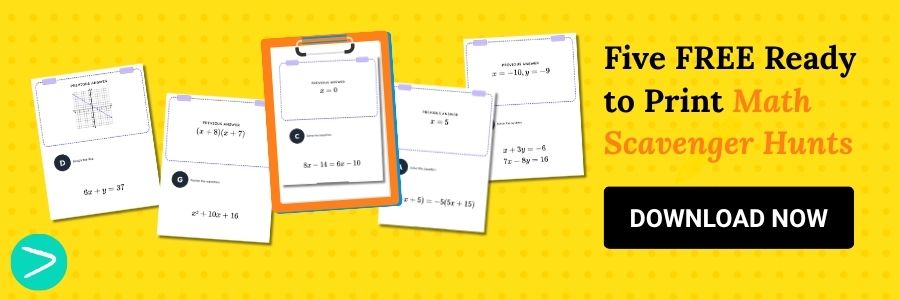
You can download all three of my favorites (plus two more) for FREE by clicking here.
Juliana's Classroom Management Hacks
A lot of teachers avoid Scavenger Hunts because they think it will turn into absolute chaos. I taught Intervention for years, and here is exactly how I kept it calm and productive:
- The "2 Minute Timer" Rule: If your students struggle with on task behavior, don't let them roam freely. Set a timer for 2-4 minutes per problem. Students must stay at their current problem and solve. When they have the answer, they can look around the room to find their next spot, but they cannot move yet. Once the timer goes off, have everyone rotate to their next answer at the same time. I count down from 10, and they move quietly and quickly. This synchronized rotation keeps the energy high but the behavior focused.
- The "Stuck Kid" Pivot: I frame getting stuck as a benefit! I tell my students: "If you look around the room and you don't see your answer, you need to talk to your team and find the error." It turns "I'm wrong" into a natural entry point for an incredible math discussion.
The Ultimate Hack: The Math Activity Accelerator
One of the biggest headaches is finding a multi step equations scavenger hunt answer key that actually matches your modified problems. With the Math Activity Accelerator, the answer key is always attached to the activity you create instantly.
Plus, we solve the two biggest Scavenger Hunt problems instantly:
- The Classroom Size Adjustment: Need more or less problems for your scavenger hunt? You can customize with the click of a button. (Have 8 tables? Make 8 problems. Want a longer block? Make 20).
- The Holiday Hack: Want to include an upcoming holiday theme on the Scavenger Hunt to the topic you're teaching? Just click the button. St. Patrick's Day? Boom. Valentine's Day? Done. You never have to buy a seasonal activity on TPT again.
Stop the worksheet fatigue and give your students a way to actually master Algebra. Math teachers: get your nights and weekends back.
Scavenger Hunt FAQ
Q: What do I do if a student just follows their friends around the loop?
A: Assign groups at the start and use the 2 minute timer rule I shared earlier. This way you’ve been clear with your expectations that students move at the same time and quietly, bringing that off task friend following to a minimum.
Q: Can I use Scavenger Hunts as an independent station instead of a whole-class activity?
A: You could, but I would suggest it for a very small group of students if they’re working independently. Make sure the content is appropriate for solo work, one of the nice things about Scavenger Hunts is that you can use more challenging content because students will have others to talk with.
Q: How do I grade a math scavenger hunt?
A: You don’t need to! It’s a self-checking math activity! If students finish a problem and don’t see the answer, they know they got it wrong. So if students finish the whole hunt, you know they got them all correct and you do not need to grade a thing!
More Activity Types
Read about all of the different activity types, download resources, and get tips with each of our Ultimate Guides:
Math teachers: get your nights and weekends back.
Finally, stop the Sunday Scramble. Instantly create the perfect, engaging math activity for your students with the click of a button.